

 English
 back
back Weitere Inhalte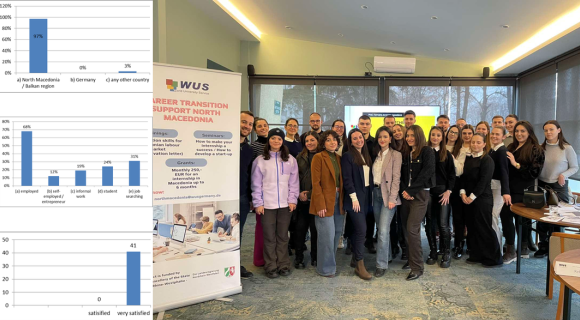
Wiesbaden, September 28th, 2026. A recent survey investigated the professional whereabouts of North Macedonian and Kosovar graduates, who participated in the fourth round of the “Career Transition Support North Macedonia” program in 2024/25, funded by North Rhine-Westphalia. The results of the survey indicate that the program is having an impact: one year after taking part in the program, the group of funded participants remains closely connected to their home country and the Balkan region. Since the program began in 2022, more than 200 candidates have been awarded funding. They received a grant to undertake a six-month internship, as well as in-depth training and seminars aimed at improving participants’ application, communication and entrepreneurial skills.
The survey, conducted in March 2026, targeted participants, who received funding from September 2024 to March 2025. Of the 50 recipients, 41 responded, yielding an 82% response rate. The non-anonymous survey featured ten partially open-ended questions and was distributed via email with a link to an online questionnaire.
The following is a summary of the survey's main findings in relation to the project's objectives. It focuses on participants' professional status, regional ties, skill development, future career plans and the sectors in which the program has had an impact:
1. Regional ties: A strong connection to North Macedonia and the Balkan region persists with 97% of participants remaining in the area one year after the program ended and only one participant now working in the USA.
2. Professional status: 68% of participants successfully entered the job market and are currently employed.
3. Business sector: The survey suggests that the program predominantly benefits the private sector, with 58% of participants employed in private enterprises. A further 17% are employed in the public sector, while the remainder is working in local NGOs (5%). The program also encourages entrepreneurship, with 12% of participants starting their own businesses.
Grant recipients rated the program, particularly the seminars and training sessions, as very helpful and beneficial. The networking aspect of the program was also rated very positively by many participants:
- The most interesting highlight for me was a lecture on entrepreneurship, especially the part about networking.
- I appreciated connecting with people from different industries, learning and gaining experience.